
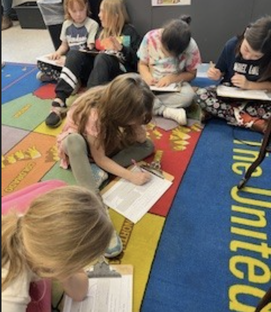
Many school districts in our region are having conversations on improving tier 1 instruction. If you have attended our Curriculum Forum this year, you probably participated in round table discussions that involved classroom core instruction. Friendship Central School began the year looking to provide teachers with professional development centered on data-driven instructional practices. Martin Pizur, Friendship Central School Building Principal, created a structure for teachers to collaborate vertically and learn from each other. The structure is called “Teacher Rounds,” and it was implemented in Pre-K through 8th grade.
Teacher Rounds is one solution to meet the needs of teachers as well as students. Taking the stance that schools are places of learning for all, Teacher Rounds provide teachers and students a safe environment to explore new learning strategies. Mr. Pizur creates a welcoming environment within the structure by ensuring the rounds are non-evaluative. He believes that teachers should have opportunities to take risks in their teaching and that students should have safety in taking risks in their learning. Teachers adhere to the structure so that the integrity of the round is honored. Students are intrinsically motivated to participate with multiple teachers providing support.
The teacher round structure has 6 steps in the framework and each step consists of essential components:
Step 1 – Identify a problem of practice
Essential Components:
Teachers gather and review data.
Coordinator proposes focus questions for discussion.
Collaboratively, the group identifies areas of student need.
Step 2 – Discuss student strengths and needs
Essential Components:
Review priority standards.
Identify student strengths and areas of need within the priority standards.
Coordinator facilitates decision-making through adult learning theory.
Step 3 – Identify evidence-based, explicit, and differentiated instructional strategies
Essential Components:
Review current practices.
Teachers and coordinator collaboratively explore instructional strategies.
Teachers choose a strategy to implement.
Step 4 -Design a lesson
Essential Components:
Teachers design a lesson incorporating chosen instructional strategy.
The lesson is written with a student-centered focus.
Teachers decide if the lesson will be modeled by an expert in the room or a collaborative lesson with coaching support.
Step 5 – Teach the lesson
Essential Components:
Students participate in learning with all teachers involved in the round.
Step 6 – Debrief the lesson
Essential Components:
Teachers review student work to evaluate student learning.
Teachers evaluate instructional strategy through the lens of student achievement.
Teachers and CABOCES coordinator determine the next steps.
Friendship Central School found success with this structure. They hope to continue the model next year and are excited to collaborate with the region on this endeavor. If you are considering implementing Teacher Rounds in your district and would like to talk further, please contact me at: michelle_rickicki@caboces.org
By: Michelle Rickicki, CA BOCES Professional Development